Home Design Consultation & Lifetime Warranty Details for Kentucky Bathroom Remodels
A Kentucky bathroom remodel typically runs from about $6,000 for a same-footprint tub-to-shower swap to $25,000 or more for a full gut remodel. The in-home design consultation is where a specialist measures your space, shows product options, and prices the work. Lifetime warranties usually cover the acrylic or PVC surround and the installation labor — read the exact terms before signing.
Call now — matched to remodelers in your ZIP

Who this guide is for and what you're deciding
You own a Kentucky home with a 20-year-old tub-shower combo, and now there's a leak underneath. Water is reaching the subfloor, and you want to know two things: what will this cost, and what are my options. This guide answers both before you sit through any appointment.
The decision in front of you is not just "repair or replace." It is a set of smaller choices:
- Same footprint or new layout? Keeping plumbing where it sits controls cost.
- Tub, walk-in shower, or full remodel? Each carries a different price band.
- Acrylic system or tile? Systems install faster; tile costs more and takes longer.
A leak under a 20-year-old unit usually means the pan, drain seal, or grout has failed. Once water gets past the surround, it rots the subfloor and can reach floor joists. That is why a simple caulk job rarely holds — the failure is behind the wall, not on it.
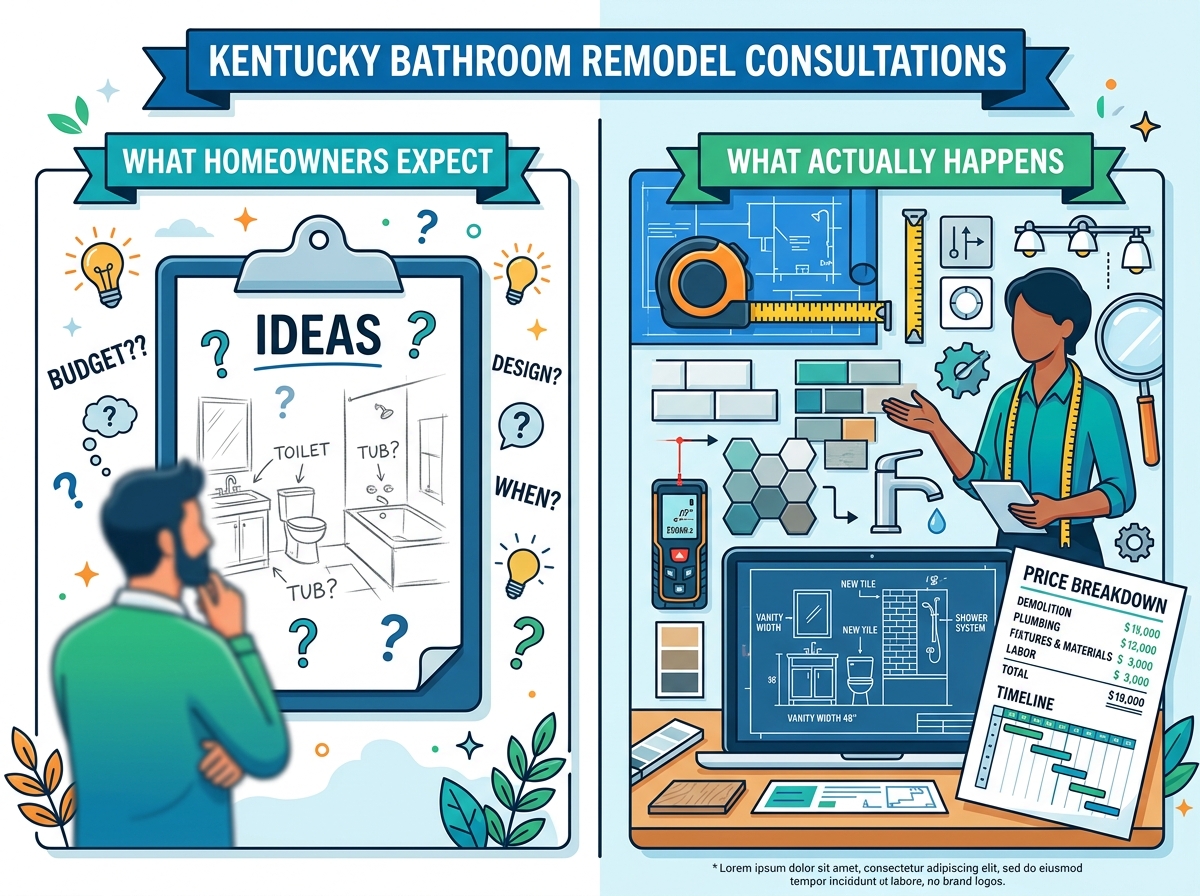
The in-home design consultation exists to answer these choices with your actual measurements in hand. A specialist looks at the leak source, the wall condition, and your plumbing, then quotes real numbers. You control the pace: you can explore options at the visit, or arrive knowing exactly what you want.
On the phone, companies will ask how long you've owned the home, how many stories it has, and when it was built. Those questions sound personal, but they help price the job — older Kentucky homes often hide galvanized pipe or non-standard framing that changes labor. You are always the one who initiates the call, and calls may be recorded. If you want a broader view first, compare paths on our bathroom remodeling options page.
What homeowners misunderstand about consultations and lifetime warranties
This is the part most people get wrong, so read it closely. Two misunderstandings cost Kentucky homeowners the most money and confusion.
1. The consultation is a measuring and pricing visit — not a repair
An in-home design consultation is when a company sends a specialist to measure your bathroom, inspect the leak, show samples, and produce a written price. No work happens that day. Its only job is to turn your rough question — "how much?" — into an exact number for your exact bathroom. Ask for the price in writing, itemized, before anyone leaves.
2. "Lifetime warranty" is not one thing — read what it names
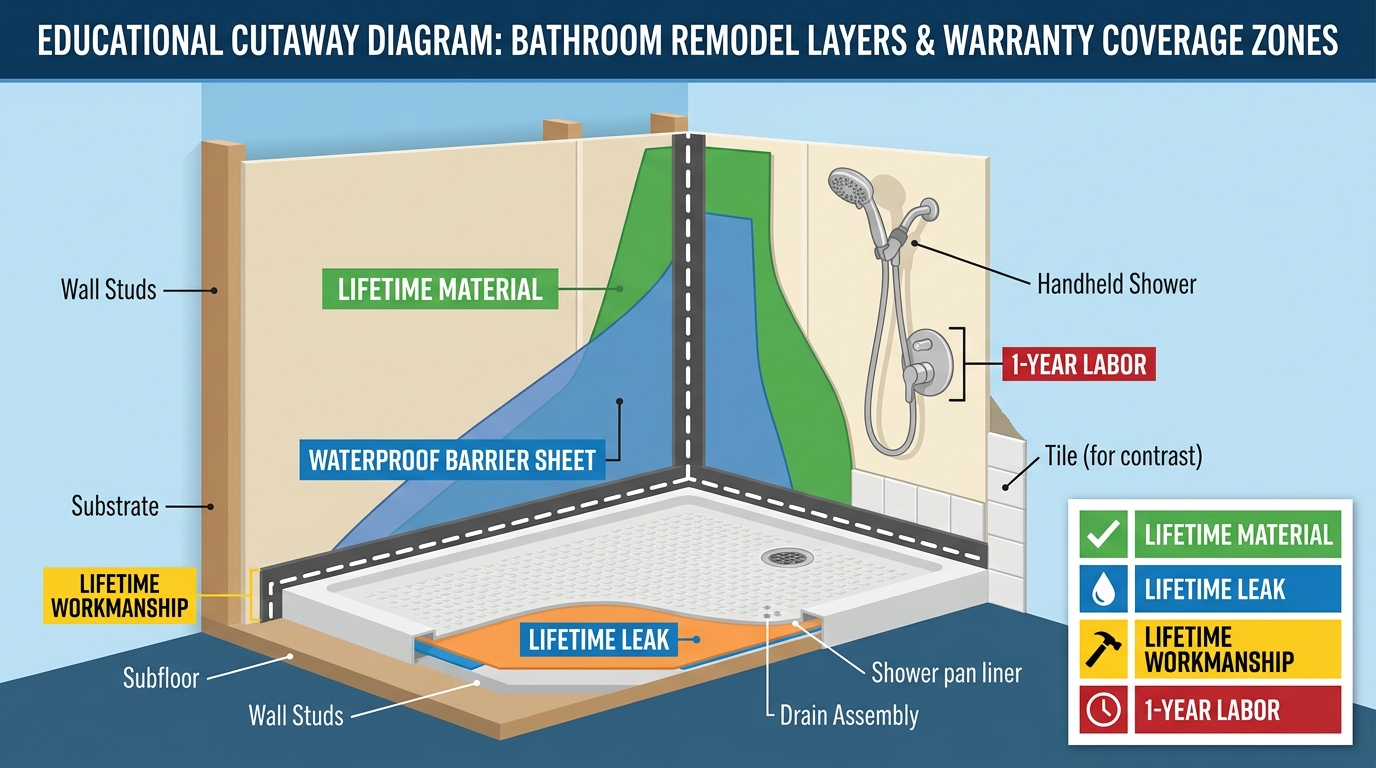
The word "lifetime" describes coverage that lasts as long as you own the home, but it rarely covers everything. Read the certificate for these three parts:
- Product warranty: covers the acrylic or PVC wall panels and base against cracking, chipping, and peeling. Often lifetime.
- Labor warranty: covers the installation workmanship — leaks caused by how it was fitted. This is often shorter, sometimes 1 to 10 years. Confirm the number.
- Transferability: some warranties end when you sell; others transfer once to the next owner. This matters for resale.
A lifetime product warranty means little if the labor warranty is one year and the leak returns in year two. The two must be read together.
Also check what voids the warranty: using abrasive cleaners, adding a third-party fixture, or moving the unit can cancel coverage. Ask whether the warranty is backed by the installer, the manufacturer, or both — if the installer closes, a manufacturer-backed warranty still stands. None of these terms guarantee an outcome; they define who fixes what, and for how long.
Signs your 20-year-old tub-shower needs replacing, not patching
A leak underneath is the loudest sign, but it is rarely the first. Here is how to read the problem before it spreads.
Signs the failure is behind the wall
- Soft or spongy floor near the tub — the subfloor is wet.
- Stains on the ceiling below a second-story bathroom, common in Kentucky's many two-story homes.
- Musty smell that returns after cleaning — moisture trapped in the wall cavity.
- Loose or cracked grout lines along the tub-to-wall joint.
- A tub that flexes when you step in — the base is no longer supported.
When you see two or more of these together, caulk and grout will not solve it. The seal that fails on a 20-year-old unit is usually the drain gasket or the pan flange, both hidden. Recaulking the visible seam only hides the leak while the subfloor keeps rotting.
Why replacement usually wins at 20 years
Acrylic and fiberglass surfaces lose their gel coat over two decades. Once that protective layer wears through, the material stays porous and holds moisture no matter how often you clean it. Mold then grows in the substrate, not on the surface, so bleach only removes the color. A new watertight system — a one-piece base and sealed wall panels — removes the seams where water escapes.
If your only issue is a worn but watertight surface, a straight swap may be enough. Our shower replacement guide covers when a like-for-like unit fits versus when you should rework the layout.
What actually works: your options from swap to full remodel
Here are the real paths for a leaking 20-year-old tub-shower, ordered from lowest to highest cost and disruption. National price ranges below are labeled as national; your Kentucky number depends on the factors in the last section.
1. Tub-to-shower conversion (same footprint)
The tub comes out; a low-threshold shower base and sealed wall panels go in where the tub sat. Plumbing mostly stays put, which controls cost. National ranges commonly fall around $4,000–$12,000. Fast — often one to three days. See our tub-to-shower conversion guide for the step sequence.
2. Like-for-like tub or shower replacement
You keep a tub or shower in the same spot with a new watertight unit. Good if you still want a tub for resale or bathing children. National ranges commonly run $3,000–$9,000.
3. Full bathroom remodel
New fixtures, flooring, vanity, and sometimes a moved wall or relocated plumbing. This is the path when the leak has damaged the subfloor or you want a new layout. National ranges commonly run $12,000–$30,000+. Our full remodel scope guide breaks down the tiers.
Acrylic system vs. tile
- Acrylic/PVC systems: non-porous, seamless, install in days, easy to clean. Most lifetime product warranties apply to these.
- Tile: more design freedom, higher cost, longer install, and grout that needs sealing every year or two.
If the leak has reached the joists, no surface product fixes it alone — the framing repair comes first, then the new unit. That structural step is where DIY most often fails.
DIY vs. calling a professional: decision criteria you can act on
Some bathroom fixes are fair DIY. A leak under a 20-year-old unit usually is not. Use these criteria to decide.
DIY is reasonable when
- You are recaulking a visibly failed seam and the floor is firm.
- You are replacing a showerhead, faucet cartridge, or drain cover.
- There is no soft floor, no ceiling stain below, and no musty smell.
Call a professional when
- The subfloor is soft — you are now dealing with structure, not surface.
- The leak reaches a lower ceiling — water has traveled and mold likely followed.
- You need to move plumbing — Kentucky requires licensed plumbing work for most drain and supply changes.
- The unit is one solid piece — removing it without cracking walls takes the right tools.
Why DIY fails here: the failure point is hidden. Without pulling the wall, you cannot see whether the pan flange, the drain gasket, or the rotted framing is the source. Homeowners often reseal the surface, the leak stops for a month, then returns worse because the wet cavity kept feeding it. A specialist opens the wall, finds the true source, and dries or replaces the framing before installing the new unit.
Answering the doubt callers voice
Callers ask, in plain words, whether the price is fair and whether they even need a pro. Fair pricing comes from comparing itemized written quotes for the same scope — same footprint, same material, same warranty terms. Get more than one. Our vetting checklist lists the exact questions to ask so you compare like with like, not apples to oranges.
Kentucky notes: permits, licensing, and local rules
Kentucky's housing stock ranges from mid-century ranches in Louisville and Lexington to older two-story homes and rural farmhouses. Many carry original galvanized supply lines or cast-iron drains that a 20-year-old surround was fitted over. That hidden plumbing is why an in-home measurement matters — the specialist checks what is behind the wall, not just the tub.
Who licenses and permits the work
- Plumbing work is regulated by the Kentucky Division of Plumbing under the Department of Housing, Buildings and Construction. Licensed plumbers handle supply and drain changes.
- Building permits are issued locally. A cosmetic surround swap often needs no permit, but moving walls, plumbing, or electrical usually does. Rules differ by city and county.
- Verify the exact permit and fee with your local building department — for example, Louisville Metro's Develop Louisville / Codes & Regulations office, or your county's building inspection office. Fees vary by city; check your local fee schedule rather than trusting a quoted figure.
Climate factors that matter here
Kentucky's humid summers and freeze-thaw winters stress bathroom seals. Humidity feeds mold in porous old surrounds; winter freezes can crack a compromised drain. A sealed, non-porous system resists both better than aging fiberglass. Good bathroom ventilation — a working exhaust fan vented outside, not into the attic — protects any new install.
Consumer protection
If a contract dispute arises, the Office of the Kentucky Attorney General, Office of Consumer Protection handles complaints. Keep every written quote, the signed contract, and the warranty certificate. Never sign a contract that leaves the labor-warranty length or the scope blank.
What drives your Kentucky price — the factors, not fake numbers
No honest guide gives one price for your bathroom, because the number moves with your specific conditions. Here are the factors that raise or lower a Kentucky quote, so you can predict where you'll land.
Factors that raise the price
- Hidden water damage: rotted subfloor or joists must be repaired first. This is the single biggest surprise on 20-year-old leaks.
- Moving plumbing: relocating the drain or valve adds licensed labor.
- Tile over acrylic: more material and more labor hours.
- Old pipe upgrades: galvanized or cast-iron lines that need replacing.
- Second-story bathrooms: harder access and ceiling repair below.
- Custom or larger footprints: more square feet, more material.
Factors that lower it
- Keeping the same footprint — plumbing stays put.
- Choosing an acrylic system over tile.
- Standard-size units that need no custom fabrication.
- A firm, dry subfloor with no structural repair.
How to get an accurate number
The written quote from an in-home consultation is only accurate after the specialist inspects the leak source and wall condition. A phone estimate is a guess; the measured quote is the real figure. Ask for it itemized so you can see the base unit, the labor, any framing repair, and the warranty coverage as separate lines.
For deeper cost breakdowns by project type, see our 2026 bathroom remodel cost guide and the walk-in shower cost page. Compare at least two itemized quotes with identical scope and warranty terms before you decide — that is how you confirm the price is fair.
Common questions
What does the in-home design consultation actually include?
A specialist measures your bathroom, inspects the leak source and wall condition, shows product and finish samples, and gives you a written, itemized price. No work is done that day — its purpose is turning your rough question into an exact number. You initiate the appointment, and calls may be recorded.
Does a lifetime warranty cover both the product and the installation?
Not always. "Lifetime" usually covers the acrylic or PVC surround against cracking and peeling. The labor warranty — covering installation workmanship — is often shorter, sometimes 1 to 10 years. Read both, plus whether it transfers to a new owner, before you sign.
Can I just recaulk a leak under a 20-year-old tub?
Only if the floor is firm and the failed seam is visible. On a 20-year-old unit, the leak is usually a hidden drain gasket or pan flange, so recaulking hides it while the subfloor keeps rotting. Soft floors or ceiling stains below mean you need a professional.
Do I need a permit to replace my shower in Kentucky?
A cosmetic same-footprint swap often needs no permit, but moving plumbing, walls, or electrical usually does. Permit rules and fees are set locally — confirm with your city or county building department. Licensed plumbing work is regulated by the Kentucky Division of Plumbing.
Why do companies ask how long I've owned my home and when it was built?
Those questions help price the job accurately. Older Kentucky homes often hide galvanized pipe, cast-iron drains, or non-standard framing that changes the labor needed. The answers let the specialist prepare before measuring your bathroom in person.
How do I know the price I'm quoted is fair?
Compare at least two itemized written quotes for the identical scope — same footprint, same material, same warranty terms. A fair price shows the base unit, labor, any framing repair, and warranty coverage as separate lines. Matching scope is how you compare fairly.
Related: tub-to-shower conversion guide · 2026 bathroom remodel cost guide · shower replacement guide · vetting checklist · full remodel scope guide
Call now — matched to remodelers in your ZIP